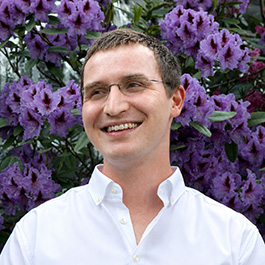
Sustainability and Energy Fellow
2026 Cohort
PhD program: Microbiology, University of California, Berkeley, California
Fellowship mentors: Amy C. Rosenzweig, PhD, Department of Molecular Biosciences, Weinberg College of Arts and Sciences, and Keith E.J. Tyo, PhD, Department of Chemical and Biological Engineering, McCormick School of Engineering
David Alfred Otto Meier completed his BA at Hampshire College with a concentration in microbiology and organic chemistry. During his undergraduate studies, he researched how microorganisms exchange energy under anaerobic conditions in the laboratory of Professor Derek Lovley at the University of Massachusetts Amherst. He then began his PhD work in the Department of Plant and Microbial Biology with Professor John D. Coates at the University of California, Berkeley. His thesis focused on how anaerobic perchlorate-respiring microorganisms survive, conserve energy, and maintain metabolic balance under nutrient limitation. He discovered the first known evidence that bacteria can produce bioplastics (polyhydroxyalkanoates) during perchlorate respiration. His work combined laboratory experiments with large-scale computational analyses to explore how microorganisms manage carbon and energy, with implications for the development of sustainable biomanufacturing technologies.
As a Trienens Fellow, David will work with Professor Amy Rosenzweig and Associate Professor Keith E. J. Tyo to study how methane-consuming bacteria can be engineered to economically and sustainably produce value-added products. Biomanufacturing often requires large amounts of oxygen, making microbial-based technologies discovered in the laboratory expensive and energy-intensive at an industrial scale. His research will develop alternative biological systems that reduce these energy demands while simultaneously converting methane, a potent greenhouse gas, into valuable products such as fuels and industrial feedstock chemicals. His long-term goal is to develop biological platforms that make biomanufacturing more energy efficient, economically viable, and environmentally responsible.