The Capture Pillar
Capturing carbon and critical resources
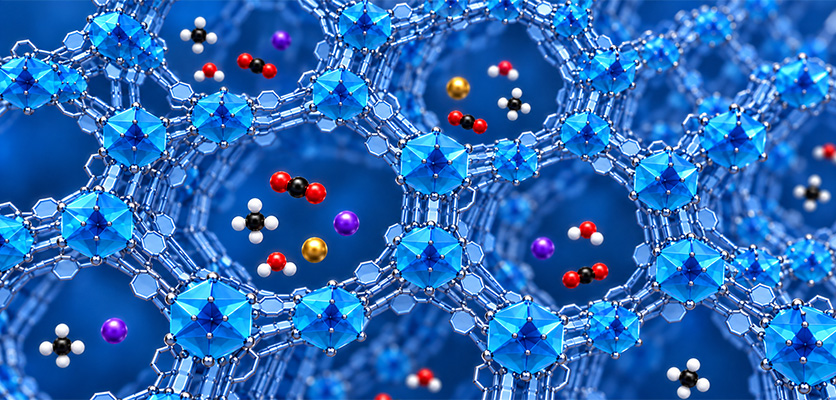
The Capture Pillar aims to address interconnected energy-security, resource and climate challenges by developing materials and processes that selectively capture valuable or harmful substances from dilute sources. Its researchers are advancing materials and technologies to remove carbon dioxide emissions from sectors that are difficult or impossible to mitigate through renewable energy and efficiency alone. The group applies the same expertise in nanoporous materials, electrochemical separations, and low-energy regeneration to harvest water from the atmosphere, and recover lithium and rare-earth elements from brines, wastewater, mine waste, and recycling streams. Together, this work could reduce greenhouse-gas emissions, expand access to clean water, strengthen critical-mineral supply chains, reduce reliance on environmentally disruptive mining, and transform waste streams into useful resources.
Research priorities
The pillar’s work is organized around several principal research priorities. Across these priorities, the central objective is to make materials and related technologies more selective, durable, energy-efficient, scalable, and practical for real-world deployment.
Carbon capture
Researchers are designing metal-organic frameworks and other porous materials that can capture carbon efficiently at low concentrations. They are particularly focused on materials that maintain their performance in humid conditions and remain stable when exposed to steam, nitrogen oxides, sulfur oxides, and other components of industrial gas exhausts from sources such as natural gas power plants powering data centers. Investigators in the pillar are also developing electrically controlled materials and processes that capture or release carbon dioxide and finding less energy-intensive ways to efficiently release concentrated carbon dioxide from capture materials to reduce the energy demand and cost of the process.
Capturing water and methane
The Capture Pillar is expanding its research to address water scarcity and methane emissions. Researchers aim to design nanoporous materials that can draw water vapor from the atmosphere and release it with minimal energy, potentially providing water in arid or off-grid locations. They are also exploring materials that selectively capture methane from air, biogas, and other dilute sources. This work could prevent a potent greenhouse gas from reaching the atmosphere while improving the purification and storage of methane for use as an energy resource.
Expanding to capture rare-earth elements
The Capture Pillar is extending its research agenda to include separations of lithium isotopes for thermonuclear energy, and rare-earth elements—critical materials used in batteries, electric motors, renewable-energy technologies, and advanced electronics. The group aims to develop technologies that selectively extract these valuable elements from dilute and complex sources such as geothermal brines, industrial wastewater, mine waste, and recycling streams. These technologies could strengthen critical-mineral supply chains, reduce reliance on environmentally disruptive mining and chemical-intensive processing, and transform underused waste streams into domestic sources of materials essential to the clean-energy transition.
Core faculty
- Randall Snurr, PhD, Capture co-chair
- Omar Farha, PhD, Capture co-chair
- Filip Formalik, PhD, Capture research faculty
- Xiaoliang Wang, PhD, Capture research faculty
Get involved
Individuals and companies can support research in the Capture Pillar by making a gift to the Trienens Institute. Industry professionals and other leaders can have a broader impact through the Trienens Institute Executive Council and Industry Affiliates Program.