AI can make science faster and more efficient, but efficiency alone is not scientific progress. We need to make sure AI expands the range of questions scientists pursue rather than simply reinforcing familiar directions.”
Rethinking how science gets done in the age of AI
Artificial intelligence is rapidly changing how scientists work. Researchers are using AI to analyze complex datasets, identify patterns, search scientific literature, write code, develop research ideas, and prepare grant proposals.
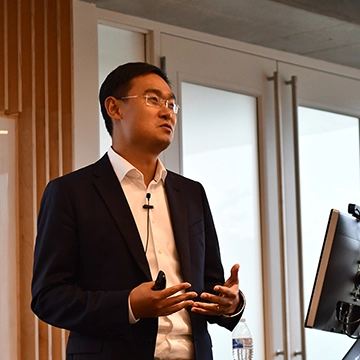
For Dashun Wang, those changes raise a larger question: What happens when AI becomes embedded not just in individual experiments, but in the process of science itself?
Wang, the Kellogg Chair of Technology and a professor of Management & Organizations, leads Northwestern’s Center for Science of Science and Innovation, where his research uses large-scale datasets and computational methods to understand how science works. In recent years, his group has increasingly turned that lens toward AI, studying where it could have the greatest impact on discovery, how researchers are already using it, and what it could mean for scientists to work alongside increasingly capable AI systems.
Across that work, Wang and his collaborators have found enormous potential for AI to accelerate parts of the research process. At the same time, their research is revealing new questions about access, originality, trust, and whether widespread AI use could unintentionally narrow the range of ideas scientists pursue.
Mapping the spread and potential of AI in science
One of the group’s first challenges was understanding where AI was already being used in science. In a 2024 study published in Nature Human Behaviour, Wang and Jian Gao analyzed tens of millions of scientific papers to measure the spread of AI across research fields. They found that AI use had expanded across nearly every scientific discipline and accelerated sharply after 2015. Papers incorporating AI also tended to receive more citations and reach researchers outside their own disciplines, although the researchers cautioned that the relationship did not establish that AI itself caused greater scientific impact.
The study also revealed a substantial gap between AI’s potential applications and its actual use. By comparing the tasks AI systems can perform with those researchers carry out across different disciplines, the team identified areas where AI appeared capable of contributing but adoption remained relatively limited.
That gap was not simply technological. AI education did not necessarily align with the fields where the technology could be most useful, while fields with larger shares of women and underrepresented minority scientists tended to have lower levels of AI use and potential benefit. The findings suggested that access to AI expertise and training could shape which researchers and fields benefit most from the technology.
Examining how generative AI may shape scientific ideas
The emergence of generative AI introduced another question: What happens when AI becomes involved in deciding which scientific ideas receive funding?
In a 2026 study published in Proceedings of the National Academy of Sciences, Wang and his collaborators examined LLM use in NSF and NIH research proposals and awards from 2021 through 2025. LLM involvement rose sharply beginning in 2023 following the public release of ChatGPT.
Across both agencies, greater LLM involvement was consistently associated with research ideas that were less semantically distinctive from projects the agencies had recently funded. Even when comparing proposals submitted by the same investigator, greater LLM involvement corresponded with ideas positioned closer to the existing funding landscape.
The researchers cautioned that the findings do not show that LLMs caused proposals to become less distinctive. Scientists could simply be more likely to use them for projects that already fit established priorities. Still, the results offered early evidence that generative AI is becoming embedded in the systems that determine which scientific ideas receive public investment.
The work also highlights a limitation of generative AI. AI can dramatically reduce the time required to write, revise, and synthesize information, but scientific discovery involves bottlenecks that better writing cannot eliminate. Experiments still need to be conducted, data collected, research teams coordinated, and new ideas tested in the real world.
Building an AI collaborator for scientific research
Wang’s group is also exploring what happens when AI moves beyond helping scientists communicate their work and begins participating more directly in research.
In Nature Computational Science, Wang and his collaborators introduced SciSciGPT, an open-source prototype AI research collaborator developed using the science of science as a testbed. Rather than functioning only as a chatbot, SciSciGPT coordinates specialized AI agents capable of searching scientific literature, retrieving data, conducting statistical analyses, producing visualizations, and evaluating their own results.
In one demonstration, the researchers asked SciSciGPT to build a network showing collaborations among Ivy League universities between 2000 and 2020. The system identified the necessary data, standardized university names, wrote database queries, constructed the network, and refined its results.
In another experiment, researchers gave SciSciGPT an image of a figure from a previously published paper. The system interpreted the figure, queried data from more than 9 million scientific papers, and recreated the analysis, reproducing the study’s general finding about the relationship between scientific team size, citations, and disruptive research.
A preliminary evaluation also suggested the potential for substantial efficiency gains. SciSciGPT completed a set of research tasks in about 10 percent of the average time required by three researchers using conventional AI tools such as ChatGPT and Claude. The authors cautioned that the experiment involved only three researchers and was intended as an exploratory demonstration.
The system also showed why human oversight remains essential. Researchers identified cases in which SciSciGPT made questionable analytical choices, mishandled database queries, or struggled with advanced statistical methods. Scientists remained responsible for evaluating and validating its results.
For Wang and his collaborators, systems like SciSciGPT therefore represent less a vision of autonomous science than a new model for collaboration. In a 2026 Nature commentary, he compared emerging AI agents to “aeroplanes for the mind”: systems that could fundamentally expand what researchers are capable of doing rather than simply automate existing scientific tasks. The goal, he argues, should be to design AI research platforms that preserve human creativity, responsibility, and the capacity for unexpected discovery.
“What excites me most is the possibility of humans and AI becoming genuine research partners—combining AI’s ability to process information and recognize patterns with human judgment and creativity to make discoveries that neither could achieve alone,” Wang said.
Taken together, Wang’s research captures AI’s growing role in science from multiple directions: where it can contribute, how researchers are already using it, how it may influence which ideas receive funding, and what it could mean to work alongside increasingly capable AI research systems.
As those systems improve, the question facing science may no longer be simply whether researchers will use AI. It will be how to capture its ability to accelerate discovery while preserving the originality, diversity, transparency, and human judgment on which scientific progress depends.
Selected publications
Gao, J., & Wang, D. (2024). Quantifying the use and potential benefits of artificial intelligence in scientific research. Nature Human Behaviour, 8, 2281–2292. https://doi.org/10.1038/s41562-024-02020-5
Qian, Y., Wen, Z., Furnas, A. C., Bai, Y., Shao, E., & Wang, D. (2026). The rise of large language models and the direction and impact of US federal research funding. Proceedings of the National Academy of Sciences, 123(33), e2601439123. https://doi.org/10.1073/pnas.2601439123
Shao, E., Wang, Y., Qian, Y., Pan, Z., Liu, H., & Wang, D. (2026). SciSciGPT: advancing human–AI collaboration in the science of science. Nature Computational Science, 6, 301–315. https://doi.org/10.1038/s43588-025-00906-6
Wang, D. (2026). AI agents are ‘aeroplanes for the mind’: five ways to ensure that scientists are responsible pilots. Nature, 651, 32–34. https://doi.org/10.1038/d41586-026-00665-y