Most catalyst research asks, ‘Which material is best?’ A more interesting question is, ‘Which operational pathway produces the best catalyst?' ”
Teaching AI How Catalysts Change Under Operating Conditions
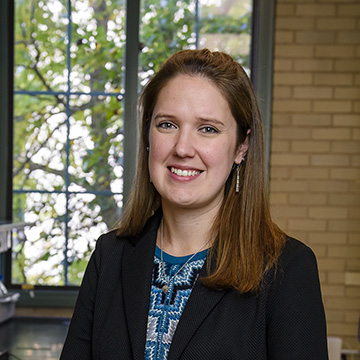
Linsey Seitz is an associate professor of chemical and biological engineering, director of the Center for Catalysis and Surface Science, and co-lead of the Transform pillar at the Trienens Institute for Sustainability and Energy at Northwestern. She studies how electrocatalysts behave in the conditions where they actually operate. Electrocatalysts increase the rate of electrochemical reactions without being consumed or permanently altered. They have applications in areas including energy, heavy industry, environmental engineering, and chemicals manufacturing. Seitz’s group supports technologies such as clean hydrogen production, carbon utilization, and circular materials recovery and processing.
One research challenge is that catalysts can look stable on the benchtop but fail in practice. For example, in the acidic, oxidizing environment of a proton exchange membrane electrolyzer, catalyst surfaces dissolve, reconstruct, and change oxidation state. Most computational screening still evaluates pristine crystal structures, which means predictions can miss the material that actually does the work. Seitz’s group treats this gap as both a scientific problem and a design opportunity, and it's where AI can help most.
Designing catalysts that are meant to change
Rather than hoping a catalyst will resist restructuring, Seitz designs materials to guide their evolution into highly active states under reaction conditions. Her group has exploited selective dissolution of specific metal ions to reshape iridium oxide materials—an important catalyst family for challenging electrochemical processes—into highly active paracrystalline structures. The new structure delivers superior performance, lasts longer, and uses less rare and expensive iridium. They have also developed a precious-metal-free manganese oxychloride catalyst that stays active in acid, even though equilibrium thermodynamics predicts it should be highly unstable. Cases like these show why predictions based on pristine structures need to account for how catalysts evolve in real applications.
A robotic platform built for dynamic catalysts
Through a National Science Foundation–supported collaboration with Jeff Lopez, Seitz’s group built an automated, high-throughput electrochemistry testing platform. A robotic system handles a custom 24-well plate with each well containing a complete three-electrode cell. Each well operates independently, allowing the system to run multiple standard electrochemical tests on 24 samples simultaneously. Tests follow a standardized protocol designed to detect early catalyst evolution, and the platform has shown reproducible results across all 24 cells. Finally, the system feeds each sample’s metadata and electrochemical output into a structured database, where custom scripts automatically process the data and calculate activity and stability metrics.
The team couples this fast testing with advanced diagnostics. They developed ultra-sensitive liquid testing methods to measure exactly how much metal dissolves during each testing protocol, and they use high-powered X-ray beams at Argonne National Laboratory to watch catalysts change in real time. They are currently focusing on a massive family of catalysts made from cheap, abundant elements. Because this family is too large to test by hand, the team is building a robotic system to automatically synthesize these materials, fully connecting the loop from creating catalysts to testing them.
Capturing what is usually left out
Predictive models are only as good as the data researchers feed them, and researchers rarely record much of what shapes catalyst performance. Seitz’s group systematically analyzes the often-ignored factors beyond the catalyst itself. For example, they compared eight carbon paper substrates and found that how a catalyst ink is formulated and deposited changes the measured performance. They also quantified the effect of experimental startup procedures. The team found that simply exposing a catalyst to partial reaction conditions in an extremely acidic or basic environment for up to 10 minutes before the intended test begins can have an unexpectedly large impact on measured performance.
Beyond her lab, Seitz has helped lead community efforts to make electrochemistry testing more rigorous, standardized, and reproducible. This kind of carefully controlled, richly detailed data is essential because it forms the trustworthy foundation needed to train smart artificial intelligence (AI) models to discover new materials.
Feeding agentic AI for manufacturing
Seitz’s group is part of a team funded in Phase I of the U.S. Department of Energy’s Genesis Mission, led by Ted Sargent with Jeff Lopez and Chris Wolverton at Northwestern and Max Delferro and colleagues at Argonne National Laboratory. The project aims to develop a two-step process that electrochemically converts harmful waste gases, including carbon dioxide and carbon monoxide, into ethylene. It then thermochemically upgrades it to polyethylene, the world’s most common type of plastic. Their proposed method uses less energy and wastes fewer atoms than traditional industrial fossil-fuel manufacturing.
The challenge is that the two steps cannot be optimized separately. What happens in the first step directly changes the purity and mixture of the gases fed into the second step. They must be perfectly synchronized to work together.
To tackle this complex problem, the team is using cutting-edge automation. They built an intelligent AI system that studies experimental results, digitally simulates the chemical reactors, and recommends the most promising experiments to try next, while documenting its reasoning along the way.
The team at Northwestern will use an automated robotic system to run many experiments at once. This system will quickly gather clean, organized information that an AI system can easily read and study. They will collect data on copper materials that change shape while working and the specialized plastic-like environments (ionomers) that enclose and protect them. They will also gather data on a variety of real-world operating conditions, like voltage and temperature, to see how the system responds. These datasets are richly labeled and keep the failed experiments, which are often the most informative. As in Professor Seitz’s other work, understanding why a catalyst fails or changes over time is often key to making it succeed.
Next: learning how catalysts evolve
Looking ahead, Seitz sees an opportunity to move AI in electrocatalysis from predicting what a catalyst is to predicting what it becomes. Her group’s datasets link a catalyst’s starting structure, its activation and testing history, and its long-term activity and stability, which makes it possible to ask whether an AI model can learn that evolution. If it can, early measurements might forecast long-term durability, shortening the lengthy tests that limit catalyst screening. AI could also help identify the best way to activate and operate a catalyst, not just the best starting material.
From catalysts to the broader energy system
The same focus on history, conditions, and dynamic system response extends to Seitz’s other work, including electrochemical metals recovery from waste streams and the coupling of carbon dioxide with organic molecules to make useful chemical building blocks. In all of these projects, success depends on the material's entire journey. You cannot look at a catalyst at just one single moment or setting. Instead, you have to look at how it constantly reacts and changes at the boundary where the chemicals meet.
To speed things up, she plans to use automated robotic systems to test large groups of advanced chemical reactors simultaneously. This high-speed testing bridges the gap between small lab experiments and heavy-duty, real-world factory operations.
Across these projects, Seitz grounds AI in the experimental reality of dynamic materials, including how they are made, tested, and changed. By treating evolution as the thing to be learned, her group aims to shorten the path from catalyst discovery to durable, affordable clean energy technologies.
Selected Publications
Lu, B., Wahl, C., dos Reis, R., Edgington, J., Lu, X. K., Li, R., Sweers, M. E., Ruggiero, B., Gunasooriya, G. T. K. K., Dravid, V., & Seitz, L. C. (2024). Key role of paracrystalline motifs on iridium oxide surfaces for acidic water oxidation. Nature Catalysis, 7, 868–877. https://doi.org/10.1038/s41929-024-01187-4
Li, R., Nordlund, D., & Seitz, L. C. (2024). Material dynamics of manganese-based oxychlorides for oxygen evolution reaction in acid. Chemistry of Materials, 36(3), 1299–1307. https://doi.org/10.1021/acs.chemmater.3c02362
Edgington, J., Vicente, R., Vispute, S., Li, R., Sweers, M., Sullivan, S., Fernandez, P., & Seitz, L. C. (2024). Dynamics of highly active Ln₃IrO₇ catalysts for the oxygen evolution reaction in acid. Advanced Energy Materials, 2402333. https://doi.org/10.1002/aenm.202402333
Li, R., Lu, B., Edgington, J., & Seitz, L. C. (2024). Dynamic interactions between adsorbates and catalyst surfaces over long-term OER stability testing in acidic media. Journal of Catalysis, 431, 115387. https://doi.org/10.1016/j.jcat.2024.115387
Edgington, J., & Seitz, L. C. (2023). Advancing the rigor and reproducibility of electrocatalyst stability benchmarking and intrinsic material degradation analysis for water oxidation. ACS Catalysis, 13(5), 3379–3394. https://doi.org/10.1021/acscatal.2c06282
Tackett, B. M., et al. (2026). Rigor and reproducibility in electrocatalysis: Best practices for operando studies. ACS Catalysis, 16(15), 13861–13877. https://doi.org/10.1021/acscatal.6c01946