Applying chemistry to create sustainable textiles
Postdoctoral fellow Katie Weber aims to make textile production more sustainable.
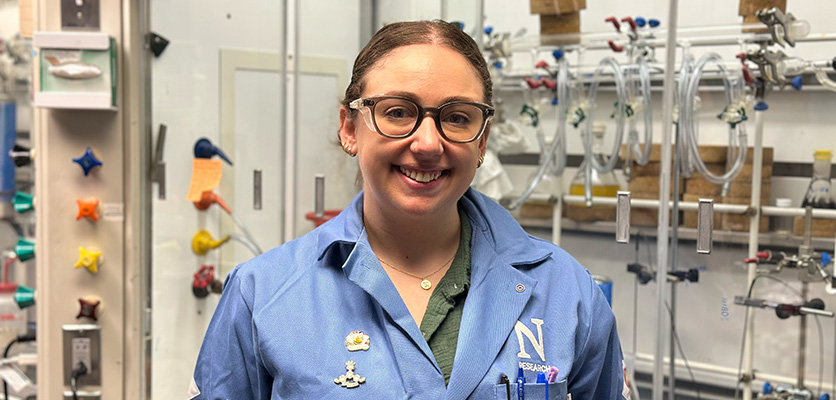
This summer, the Trienens Institute announced the first cohort of Northwestern University Sustainability Fellows. This three-year fellowship focuses on training exceptional postdoctoral scholars poised to help drive the energy transition. Katie Weber came to the fellowship program from the University of Wisconsin–Madison, where she completed her PhD in Organic Chemistry. During her fellowship, Weber will work with mentors Julia Kalow and Cécile Chazot to develop textiles that have color built into their molecular structure. She aims to make textile production more sustainable by eliminating the need for toxic dyes and water-intensive dyeing processes. Weber shared her thoughts about why she chose to come to Northwestern for her postdoctoral work.
What do you find most exciting about the Northwestern University Sustainability and Energy Fellows program?
Northwestern has countless world-class faculty members, and I am excited to work with not one but two of them through this fellowship. I was familiar with both Julia Kalow's and Cécile Chazot’s research programs, and I thought I would have to choose one for my postdoctoral research. This fellowship allows me to work with both of them on an independent project I would not otherwise have had the opportunity to pursue. I am also excited about the independence offered in this fellowship, as I get to choose my own direction for my research and make my own path in this field.
What makes this fellowship opportunity stand out among other postdoctoral programs?
Firstly, I am passionate about using chemistry to solve sustainability challenges, so the mission and vision of the Trienens Institute were particularly compelling. Additionally, the interdisciplinary nature of this fellowship is exciting, as postdoctoral positions are often centered on a single research group. The level of independence afforded by this fellowship is also somewhat uncommon, and this was particularly attractive as it will better prepare me for my future career as an R1 faculty member. I am also excited to have a cohort of fellow postdocs to collaborate with and learn from, as that is something I really valued about my graduate school experience. Finally, I think the networking opportunities with stakeholders outside of academia or major chemical companies will bring invaluable perspectives to the work I do.
What will you work on during your fellowship?
My project focuses on the design of novel polymer materials to enable the development of sustainable textiles. Polymers are long molecules made of smaller repeat units, like beads on a necklace. For example, proteins are polymers where the “beads” are made of amino acids. Plastic bags, such as those you might find in a supermarket, are made of polymers such as polyethylene. Your favorite athletic shorts are made of polyester, nylon, and spandex, all of which are polymers. While these fabrics have fantastic properties, they are not great for the environment. These polymers are derived from fossil fuels, and water- and labor-intensive processes involving toxic dyes are required to create colorful fabrics to make the brightly colored clothes we want to wear.
While dyes, or colorful molecules, are one source of color in nature, it is not the only source. Many insects, such as butterflies and beetles, get their color from the organization of polymers in their wings and shells. This organization occurs spontaneously with an incredible degree of order and results in what is referred to as “structural color,” that is, the color comes from the structural organization, rather than from the addition of exogenous dye molecules.
My goal is to reproduce structural color in fibers using cellulose, a natural, sugar-based polymer, as the starting material. Some forms of cellulose are known to exhibit structural color when in a gel phase; however, most of the time the color goes away as soon as the solvent is removed. This means it cannot be spun into colorful fibers to weave a fabric. My project focuses on the design of “linkers,” or small molecules that could be introduced to stabilize the structural color, so it is not lost upon drying. These molecules would not be dyes, meaning they would not be adding the color to the fiber; rather, they would be preventing the existing color from disappearing in the fiber spinning process. Crucially, I envision using dynamic, rather than permanent, linkers to enable recycling of the resulting textiles back into their component parts under mild conditions. By changing the chemical nature of the linkers, I envision altering the overall organizational structure and therefore changing the structural color observed.
How does your research address real-world challenges in energy or sustainability?
The overall goal of this project is to completely change the way we color textiles. Right now, we use toxic dyes and solvents, in addition to a water-intensive dyeing process. The resulting runoff is filled with toxic chemicals, which further pollutes our water systems. By eliminating the need for dyes and instead making use of the structural color exhibited by these polymers, we can prevent further pollution of our waterways.
Furthermore, massive amounts of textile waste are generated each year, whether from fabric scraps or discarded clothes, and the rise of fast fashion is further exacerbating this problem. Most of this waste ends up in landfills and further pollutes the environment, as recycling programs aren’t sufficiently robust to keep up with the existing waste stream. I have a different vision.
Imagine if one day you could buy, for example, a blue T-shirt. Maybe you wear it for a few years and are sick of it, or your child outgrows it. Rather than donating it and hoping it doesn’t end up in the landfill, you could send it back to the company, and they could break it down into its component parts (in this case, the cellulose and the linker molecule), swap out the linker, and generate a new, red T-shirt from the same original cellulose materials, without the use of harsh chemicals to strip and re-dye the fabric. We’re a long way from this goal, but I hope my research will help move us in the right direction!
What do you hope to learn from your fellowship experience and your mentors in particular?
There is so much I want to take away from this fellowship! My background is in synthetic organic chemistry, meaning I mostly worked with small molecules. Now, I am transitioning to the world of macromolecules, meaning I have a new set of fundamental theoretical principles, in addition to new synthetic and characterization techniques, to master. I hope to learn more about covalent adaptable networks alongside Julia Kalow, who is an expert in this field. Additionally, I look forward to learning about liquid crystalline materials and optical characterization with Cécile Chazot. I am also excited to learn more about the differences in leading a research group between chemistry and engineering departments, and to further refine my vision for running a lab one day.
What do you look forward to about your time at Northwestern and in the Evanston and Chicago area?
I have quite a bit of family in the surrounding area, so I am excited to spend time with them! I also look forward to spending time enjoying Lake Michigan and exploring all the city has to offer!
Outside of your work, do you have any hobbies or interests you would like to share?
Outside of work, I enjoy crafting, attending barre and yoga classes, taking care of my plants, and spending time with my cat, Agatha.