Making the most of methane
Postdoctoral fellow David Alfred Otto Meier aims to transform a potent greenhouse gas into valuable products.
This summer, the Trienens Institute welcomes the first cohort of Northwestern University Sustainability Fellows. This three-year fellowship focuses on training exceptional postdoctoral scholars poised to help drive the energy transition. David Alfred Otto Meier comes to the fellowship program from the University of California, Berkeley, where he completed his PhD in microbiology. As a fellow, his research will focus on engineering methane-consuming bacteria to produce value-added products economically and sustainably.
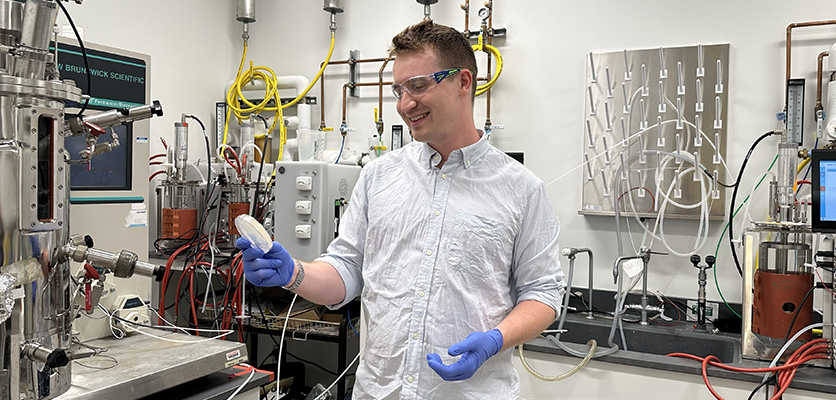
Meier aims to develop biological systems that reduce the energy demands of biomanufacturing while simultaneously converting methane, a potent greenhouse gas, into valuable products such as fuels and industrial feedstock chemicals. He shared thoughts about starting his journey as a postdoctoral fellow.
What do you find most exciting about the Northwestern University Sustainability and Energy Fellows program?
What really stood out to me was the interdisciplinary nature of the program. I'm excited that it brings together not just chemists or microbiologists, but researchers from a wide range of disciplines. That diversity was evident during the interview process, where the interview panel included professors of chemistry, geology, and law. To me, that reflects what sustainability is all about. Addressing complex challenges like climate change requires scientists, engineers, policymakers, and many others working together toward a common goal.
I was also drawn to the collaborative nature of the fellowship. Scientific discoveries alone aren't enough. They need effective translation into technologies, policies, and real-world solutions to make a meaningful impact. The fellowship's emphasis on collaboration, professional development, and translating research into practice makes it a truly unique opportunity for postdoctoral researchers.
What makes this fellowship opportunity stand out among other postdoctoral programs?
What stands out most to me is the program’s long-term vision. Beyond supporting individual research projects, it is building a community of scientists from different disciplines who share a common goal of advancing sustainable solutions. That kind of network is incredibly valuable because the most impactful ideas often emerge through collaborations that wouldn't happen otherwise.
I'm especially excited to connect with the other fellows and to learn from the diverse group of mentors within the Trienens Institute. Those relationships have the potential to extend well beyond the fellowship itself, creating lasting collaborations that continue to drive innovation and real-world impact throughout our careers.
What will you work on during your fellowship?
I study bacteria that naturally consume methane gas, one of the most powerful greenhouse gases. Methane is released from sources such as agriculture, landfills, wastewater treatment, and energy production. Today, methane is typically burned to recover energy, producing carbon dioxide, or released into the atmosphere rather than being used as a renewable resource for manufacturing.
My research aims to change that by engineering these bacteria to convert methane into valuable products. Instead of treating methane as a waste gas, we can use it as a renewable building block to produce materials such as sustainable fuels, plastics, pharmaceuticals, and other industrial chemicals. By turning an environmental liability into a valuable resource, I hope to help make biomanufacturing more economically viable and sustainable while contributing to a circular economy.
How does your research address real-world challenges in energy or sustainability?
Methane is released from many sources, including wastewater treatment plants, composting facilities, agriculture, and energy production. Many of these sites generate concentrated methane streams that could be captured instead of being burned or released into the atmosphere.
Initially, technologies like the one I'm developing will likely have the greatest impact at these larger emission sources, where methane capture is already practical. Over time, similar approaches could also be applied to smaller, more distributed sites.
What excites me most is the opportunity to transform methane from a waste product into a renewable resource. Instead of simply managing methane emissions, we can use them to manufacture valuable products while reducing greenhouse gas emissions. Ultimately, this helps build a circular economy, where waste streams are captured, transformed into useful products, and continually reused rather than discarded.
What do you hope to learn from your fellowship experience and your mentors in particular?
I'm excited by the opportunity to explore new biology that could make biomanufacturing more sustainable while transforming methane from a greenhouse gas into a valuable resource. Scientifically, I hope to discover new ways of engineering microbial metabolism that expand what's possible for sustainable manufacturing.
Just as importantly, I want to learn how discoveries like these can move beyond the laboratory and into real-world applications. I love fundamental science, but I'm equally passionate about seeing research make a tangible difference. One of my goals is to better understand how to translate scientific discoveries into technologies that improve sustainability and strengthen the circular economy.
I'm also honored to work with Keith Tyo and Amy Rosenzweig, who are leaders in synthetic biology and methane metabolism, and I look forward to learning from their scientific expertise. More than anything, I'm excited to work together on research that has the potential to make a meaningful impact.
What do you look forward to about your time at Northwestern and in the Evanston and Chicago area?
This might sound a little unusual, but I'm looking forward to winter. I was born in Germany, grew up in India, and then spent many years in California, so I'm excited to experience all four seasons again, but especially winter.
I'm also looking forward to exploring Chicago's architecture, culture, and food. I love cycling, so I'm excited to spend time riding along the lakefront and discovering the city. Chicago wasn't originally on my radar, but after visiting last year, I quickly realized what a vibrant and exciting place it is. I'm looking forward to making it my new home and getting to know the city.
Outside of your work, do you have any hobbies or interests you would like to share?
Outside the lab, I enjoy rock climbing, cycling, cooking, and gardening. I'm excited to take advantage of Chicago's parks and lakefront by bike, spend summer evenings grilling, and make the most of my new apartment's sunroom by growing herbs and vegetables. I find gardening to be a great way to unwind and stay connected to nature, even in the middle of a city.