Building a better solar panel
Postdoctoral researcher Diana LaFollette aims to advance the science of perovskite solar cells.
The Northwestern University Sustainability and Energy Fellows program draws top postdoctoral researchers from a wide range of academic disciplines. Diana LaFollette joined the fellowship program this September after earning her PhD in Materials Science and Engineering from the Georgia Institute of Technology in Atlanta. As a fellow, she will work with mentors Mercouri Kanatzidis and Richard Schaller to examine the fundamental processes that limit long-term stability in perovskite solar cells. LaFollette shared her thoughts about what brought her to the Northwestern campus for her postdoctoral work.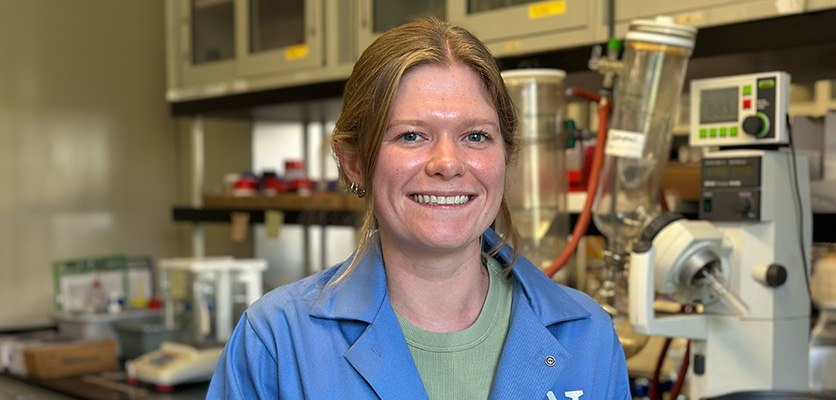
What do you find most exciting about the Northwestern University Sustainability and Energy Fellows program?
I'm super excited about the program for a variety of reasons. First, I'm excited to have the support to start an independent career and choose my own direction within the field. I'm also really excited to have the support of two co-mentors, rather than being in just one group, to have the opportunity to expand my skills and learn as much as possible. I also value the interdisciplinary possibilities and connections. All the fellows will focus on sustainability and energy, but I'll get to interact with other fellows approaching it from many different directions.
What will you work on during your fellowship?
I’ll be working on halide perovskites, which are exciting for many optoelectronic applications including solar energy, lighting, sensing, and lasing. They are commonly used in solar cells because they're low-cost, easy to make, and very efficient. However, they don’t last nearly as long as current commercially available photovoltaic materials. My research will work on understanding why perovskites don't last as long and how we can design and engineer them to last longer.
I’m interested in studying the behavior of halide perovskites at an atomic and molecular scale to understand the root cause of their instability. This means using advanced characterization to look at the material at the nanoscale over a variety of timescales to find out what happens to a solar cell from the very moment when light hits the material over hours until it begins to degrade. I want to develop an understanding of how dynamic processes involving chemistry, structure, and properties all interact to ultimately affect long term stability.
The goal is to create a framework based on characterizing how these materials behave, and then use it to design new materials. Ultimately, this could lead to better low-cost renewable energy technology with broad applications.
How does your research help address real-world challenges in energy or sustainability?
I’m studying novel semiconductors with ultimate applications in renewable energy (solar) as well as more energy-efficient lighting, sensing, and lasing. We’re accelerating renewable energy, and one exciting thing about perovskite solar cells is that they’re easy to make. Unlike current photovoltaic technologies, we could do end-to-end manufacturing in the United States without relying on other countries and manufacturers, not only supporting renewable energy development but also American energy independence.
This would make it easy for us to produce a lot of solar cells quickly and economically. What also excites me about solar energy is that it can be applied in any community. You can put it on a farm in a totally rural community, and you can put it in a city. So, I'm working toward accessible, scalable, renewable energy, based on the fundamental understanding we develop of these materials.
What do you hope to learn from your fellowship experience and your mentors in particular?
My mentors are Professor Mercouri Kanatzidis and Professor Richard Schaller. Professor Kanatzidis is a pioneer in the perovskite field, particularly in designing, synthesizing, and characterizing new materials. I’m really excited to learn more about the material design and synthesis process.
Professor Schaller specializes in ultrafast characterization, which we can use to study phenomena like how a solar cell behaves at the instant light hits the material (pico to nanoseconds). I look forward to learning from his expertise about how to characterize these ultrafast processes that are hard to visualize but very influential in the life of the material.
From the fellowship in general, I’m interested in learning more about how science can interact with policy, industry, and non-profits, and generally connecting more with those other communities. I feel that moving outside the lab is what makes science actually change the world.
What do you look forward to about your time at Northwestern and in the Evanston and Chicago area?
I’m really excited to move to Chicago and live by the lake. I’m originally from Florida, so I'm used to having access to water, and I have been landlocked for the last five years during my PhD, so I'm excited to have access to it again. I run and bike a lot, so I want to get involved with that and explore the amazing trails in Chicago. I’m also excited to be a part of the great interdisciplinary community at Northwestern with experts in literally every field.
Outside of your work, do you have any hobbies or interests you would like to share?
I run and bike a lot, and I have two dogs, so I spend a lot of time outside hiking, walking, and running with them. I love teaching, both in a formal academic setting and out in the community. During my PhD, I coached a free kids' running club two days a week, which was a fun way to get outside and connect with the community.