Engineering urban adaptation
Postdoctoral fellow Paul Ducarme envisions adaptive shape-shifting buildings to regulate heat, light, and pollution
Paul Ducarme, PhD, is a mechanical engineer and a member of the inaugural cohort of the Northwestern University Sustainability and Energy Fellows (NUSEF) program, a flagship initiative of the Trienens Institute for Sustainability and Energy. During his postdoctoral fellowship at Northwestern, he will work to develop buildings and architectural elements that passively change shape to respond to and help regulate heat, ventilation, light, and air pollution.
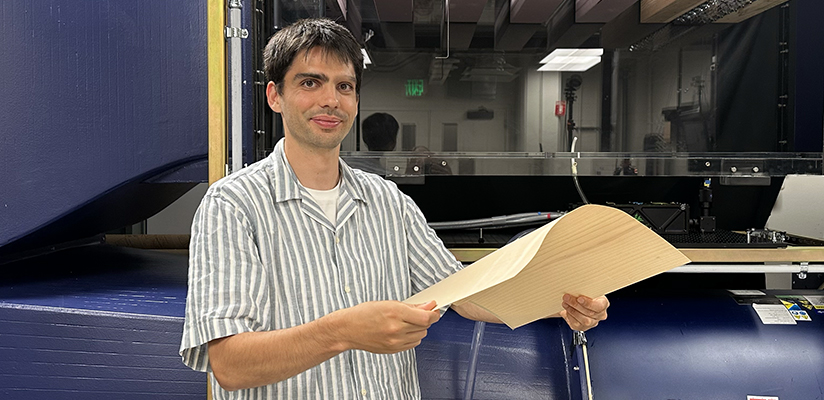
Ducarme completed his bachelor's and master's degrees in mechanical engineering at the University of Liège in Belgium before moving to Amsterdam, the Netherlands, to pursue his PhD at the AMOLF and ARCNL research institutes, graduating from the University of Amsterdam in May 2026. He arrived on campus in June 2026 to begin his three-year appointment under the mentorship of assistant professors Lucia Stein-Montalvo (Adaptive Structures Lab) and Nivedita Arora (Embodied System Lab). He shared his thoughts about what he looks forward to about the fellowship experience.
What do you find most exciting about the Northwestern University Sustainability and Energy Fellows program?
I am excited to meet my new colleagues and collaborators! Given the interdisciplinary nature of the program, I'll be working with two research labs bringing different areas of expertise and perspectives. I look forward to learning about their work and drawing inspiration for my own research. I am also excited to connect with the rest of the cohort. I am curious to know more about their projects and how we could potentially collaborate.
What makes this fellowship opportunity stand out among other postdoctoral programs?
This fellowship stood out to me because of its emphasis on creating impact beyond the academic sphere. Bridging the gap between research findings and real-world solutions is one of its main objectives, and that resonated with me.
The main finding of my PhD was the experimental demonstration of a new mechanical phenomenon, in which certain structures deform in ways that defy intuition. I showed that this phenomenon unlocks properties and functionalities that were previously unattainable. There are potential applications in nanolithography that could be explored in collaboration with an industry partner in that sector.
I believe there are many other domains where this discovery could have an impact, but realizing that potential requires sustained cross-disciplinary effort. The fellowship's three-year timeline and resources make it an ideal opportunity to support those more ambitious directions, develop them to maturity, and have a positive societal impact.
What will you work on during your fellowship?
Over recent decades, cities have faced rising temperatures driven by rapid urbanization and climate change, alongside increasingly extreme environmental conditions. Yet despite these dynamic shifts, the urban landscape itself remains largely static, posing a risk to the future livability of our cities.
My work will focus on developing buildings and structures that change shape on their own in response to changing environmental conditions. For example, instead of static facades, could we design urban elements with more lifelike qualities, such as surfaces that fold and open like a leaf or a pine cone in response to temperature and humidity?
My approach will draw on an emerging trend in mechanical engineering: harnessing instabilities, which were traditionally avoided because they were seen as a form of failure. During my PhD, I discovered a new class of instabilities that allow structures to change shape in ways never observed before, and I want to use them to give buildings inherent shape-shifting properties.
To get there, I need to understand how sensing capabilities can be woven directly into structures to trigger and orchestrate these shape changes. The goal is to create buildings that respond to and adapt to, and help regulate, wind, air pollution, heat, and light, ensuring that both indoor and outdoor urban spaces remain livable.
How does your research address real-world challenges in energy or sustainability?
My research will explore and propose new strategies to reduce reliance on traditional heating, ventilation, and air conditioning systems amid the growing pressures of climate change and urbanization. Those systems account for a significant share of total US energy consumption. Air conditioning alone uses roughly one-fifth of the electricity consumed in American homes, for instance. By embedding shape-shifting capabilities directly into structures, my work aims to develop facades, rooftops, and other architectural elements that adapt to wind and temperature to modulate passive ventilation and improve the overall energy performance of buildings.
Through the same approach, these adaptive structures can help reduce the concentration of air pollutants trapped in urban canyons by sensing pollution levels and wind direction to steer airflow through the streets or improve indoor and outdoor livability through adaptive shading. The broader vision is to develop a new class of solutions that leverage nonlinear mechanics and embodied sensing for more dynamic, life-like urban spaces: a paradigm built on passive, robust, durable, and easy-to-maintain structures, in contrast to traditional systems that are often energy-intensive, intricate, and difficult to maintain or recycle.
Through my research, I want to connect with local academic and industrial communities to build real-world prototypes and installations, making the Chicago area a living lab and showcase for adaptive structures to shape new sustainable policies in civil engineering.
What do you hope to learn from your fellowship experience and your mentors in particular?
I will work with two mentors: Dr. Lucia Stein-Montalvo and Dr. Nivedita Arora, who lead the Adaptive Structures Lab and the Embodied System Lab, respectively. On a more technical level, I want to learn more about fluid-structure interactions within Lucia’s lab, more specifically, the interplay between geometry, elastic instabilities, and airflows. In Nivedita’s lab, I want to learn about battery-free sensing systems and explore techniques to integrate them into materials and structures. I found their work and visions truly inspiring, and I hope I can learn from them how to keep growing as a researcher.
With this fellowship, I also really want to connect with people beyond the academic sphere, as I am sure I can learn a lot from them and have a concrete impact as a scientist.
What do you look forward to about your time at Northwestern and in the Evanston and Chicago area?
It is my first time at Northwestern and in the Chicago area, and my first time living in the US (I have just moved here from Europe). So, I look forward to meeting new people and learning more about American culture and how to do research here. I look forward to meeting with the rest of the NUSEF 2026 cohort and learning more about their projects.
I have explored Evanston and Chicago a little, and I was pleasantly surprised by how beautiful and bikeable the whole area seems. I look forward to exploring Chicago more and experiencing the food, museums, parks, the lake, and probably more things I don’t know about yet.
Outside of your work, do you have any hobbies or interests you would like to share?
Over the past few years, I have really enjoyed photography. I like to walk or cycle around and take pictures of anything I find aesthetically pleasing. I already love Chicago because I see a lot of potential for composing nice photos. I also like to play chess, online or over the board, go for bicycle rides, and play football (soccer), ping-pong, and volleyball.