Advancing terrestrial, concentrator, and space-based solar energy
Postdoctoral fellow Krishanu Dey aims to turn fundamental scientific discoveries into affordable, sustainable energy solutions.
The Northwestern University Sustainability and Energy Fellows program empowers top postdoctoral scholars with unprecedented research independence. Krishanu Dey joined the program after completing his PhD in physics at the University of Cambridge.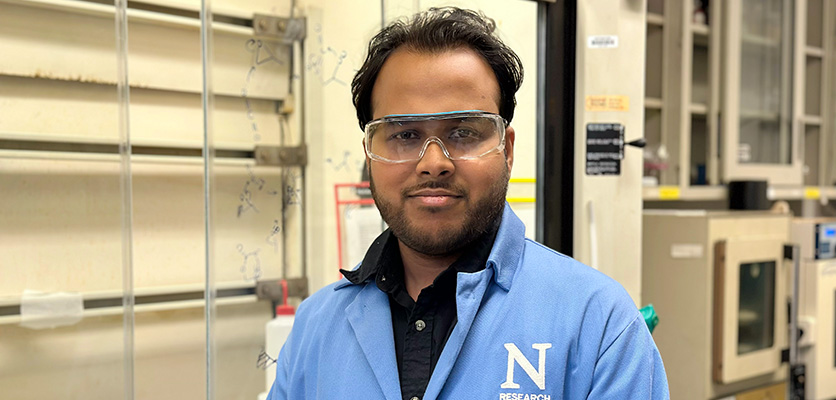
At Northwestern, Dey's research seeks to establish high-performance perovskite multijunction photovoltaics as a transformative platform for terrestrial, concentrator, and space-based solar energy applications. He shared what he looks forward to about his three-year fellowship working with mentors Richard Schaller and Mercouri Kanatzidis.
What do you find most exciting about the Northwestern University Sustainability and Energy Fellows program?
What excites me most is being part of such a diverse, interdisciplinary community of fellows, all working toward the shared goal of tackling global challenges in sustainability and the energy transition, but from very different perspectives. I have always believed that some of the best research ideas emerge when people from different backgrounds come together, challenge each other’s thinking, and exchange ideas. I am really looking forward to being part of those conversations and seeing where they lead!
Another aspect I particularly value is the freedom and independence the fellowship offers us to define our own research directions and pursue them over three years, without the constant pressure to deliver immediate results. From my experience, meaningful scientific discoveries often take time, and having that flexibility to explore ambitious ideas, take risks, and sometimes even fail is incredibly valuable.
Furthermore, the dedicated research and travel funding gives us the flexibility to attend conferences, visit research groups around the world, and build collaborations beyond Northwestern. For me, these opportunities are just as important as the research itself, as the connections we make during this period could lead to exciting collaborations that last well beyond the fellowship.
What will you work on during your fellowship?
For the last eight years, I have been working on a fascinating family of semiconductors called metal halide perovskites. What makes these materials so exciting is that they offer the best of both worlds: excellent crystalline and optoelectronic quality of inorganics, and low-temperature processability of organics. Much of my research so far has focused on understanding the fundamental properties that make these materials so promising, while also exploring their applications in solar cells, light-emitting diodes, and field-effect transistors.
At Northwestern, I will predominantly focus on understanding the unexplored photophysics and chemistry of different perovskites and related metal halides, particularly for applications in light harvesting and emission. This will involve growing single crystals and thin films with carefully tailored chemical compositions, investigating their properties using advanced characterization techniques available across the Department of Chemistry and beyond, and ultimately integrating them into functional devices. With such a closed-loop iterative framework, I hope to uncover the critical factors limiting their performance and stability and devise strategies to overcome them. Ultimately, my goal is to translate these insights into more efficient, stable perovskite multijunction solar cells for terrestrial, concentrator, and space applications.
How does your research help address real-world challenges in energy or sustainability?
Halide perovskites have seen an astronomical rise in photovoltaic efficiencies since their inception in 2009, and today they are approaching the performance of the best silicon solar cells, a technology that has benefited from over four decades of development. Naturally, this has created ripples in the energy materials community, and a growing number of startups have been set up in the United States and beyond to translate these developments from lab to fab. Despite this remarkable progress, fundamental challenges remain. Further gains in efficiency and long-term stability will depend on understanding how energy is lost and why these materials and devices degrade over time. Ultimately, once these fundamental barriers are taken care of, there is no limit to what halide perovskites can achieve and how fast they can achieve that.
What is particularly noteworthy is that halide perovskites offer simpler, potentially lower-cost manufacturing than conventional silicon photovoltaics, which could make solar energy production more accessible worldwide, diversify manufacturing, and reduce dependence on concentrated supply chains. The prospect of turning fundamental scientific discoveries into affordable, sustainable energy solutions with a truly global impact is what makes this research so rewarding.
What do you hope to learn from your fellowship experience and your mentors in particular?
Northwestern is truly a hub for perovskite research in the US, bringing together exceptional expertise in materials synthesis, advanced characterization, and device development. I feel incredibly fortunate to have Professor Mercouri Kanatzidis and Professor Richard Schaller as my co-mentors.
Professor Kanatzidis is a pioneer in halide perovskite research, with decades of experience in discovering and designing new materials for applications ranging from solar cells to thermoelectrics and radiation detection. I am particularly excited to learn from his group's expertise in materials chemistry, which will be invaluable for understanding the chemical and structural origins of degradation in perovskites.
Professor Schaller, on the other hand, brings world-leading expertise in ultrafast spectroscopy, offering powerful tools to unravel the fundamental energy-loss mechanisms that limit device performance. His joint affiliation with Argonne National Laboratory also opens exciting opportunities for me to access state-of-the-art characterization facilities at the Center for Nanoscale Materials (CNM) and the Advanced Photon Source (APS).
I will also collaborate closely with Professor Ted Sargent's group, internationally recognized for pioneering contributions to high-performance perovskite photovoltaics. Together, these complementary research environments provide an ideal opportunity for me to bring these different perspectives together to tackle challenging scientific questions, and ultimately develop the breadth and independence needed to lead my own research program in the future.
What do you look forward to about your time at Northwestern and in the Evanston and Chicago area?
After spending the last eight years in the UK and two years before that in Singapore, this is my first appointment in the U.S. I am particularly looking forward to understanding how the U.S. academic ecosystem works, meeting people from different backgrounds, and embracing the opportunities that come with it.
On a more personal note, I have always loved being close to water, so Northwestern’s beautiful lakeside campus and Chicago’s stunning location along Lake Michigan are a real treat. Of course, I have already heard plenty about the infamous Chicago winters, which I am not particularly looking forward to, but I hope the beautiful summers by the lake will more than make up for them!
Finally, as Bengalis from India, Chicago has always held a special place in our cultural and historical imagination. Being able to live and work in a city with such a meaningful connection to my roots makes this new chapter even more special.
Outside of your work, do you have any hobbies or interests you would like to share?
I absolutely love driving and exploring new places, so I can’t wait to hit the road and discover the beauty of the Midwest and beyond, especially when the weather is on my side.
I am also a huge cricket enthusiast and am excited to follow the growing popularity of Major League Cricket (MLC) in the U.S. With a new Chicago franchise reportedly set to join the league from the 2027 season, I am particularly looking forward to cheering for the local team and hopefully watching some matches in person.